
HEREDITY BIOSCIENCES, BHUBANESWAR
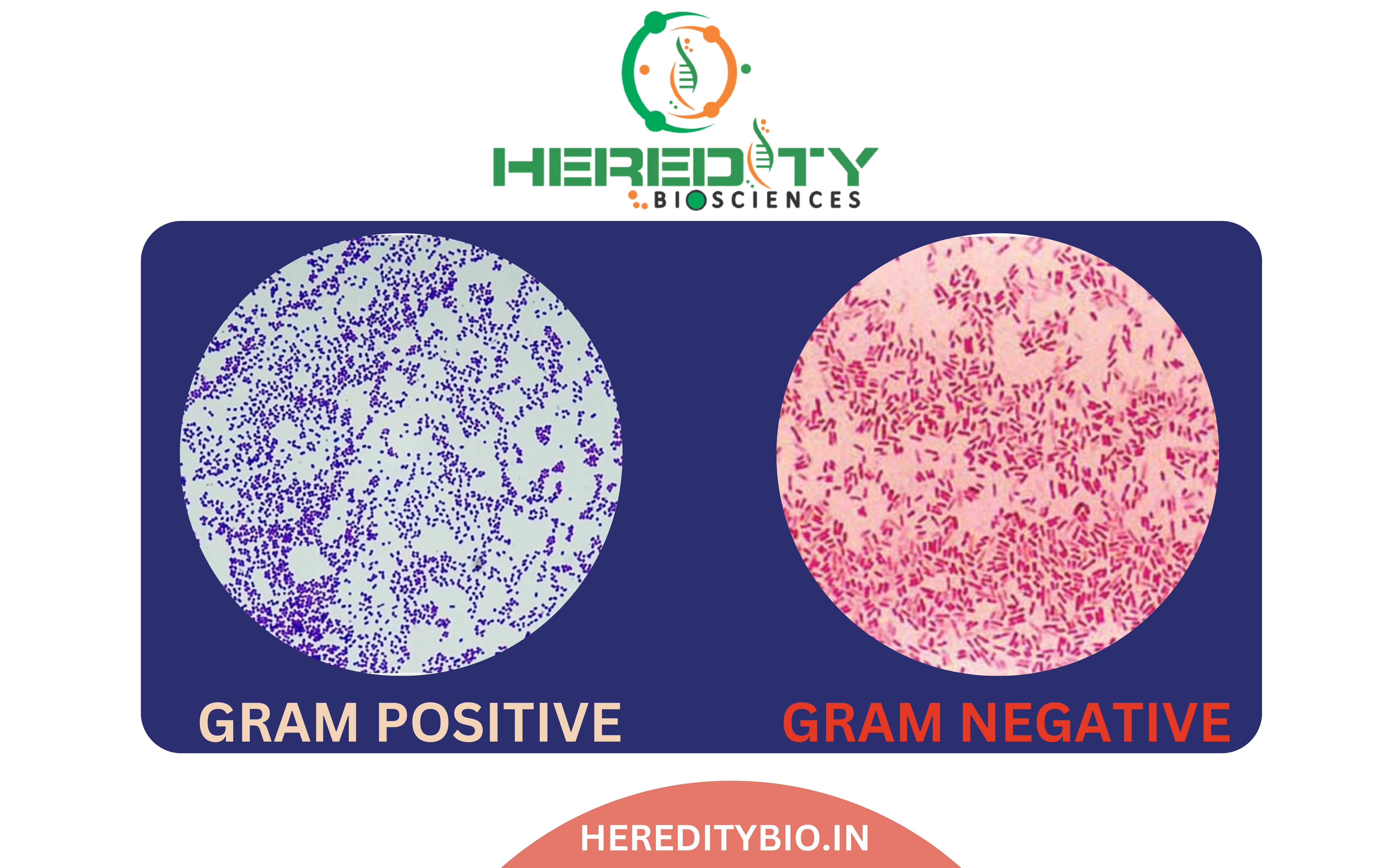
Gram-positive and Gram-negative bacteria are two distinct groups of bacteria that can be differentiated based on their response to the Gram staining technique. The key difference lies in the composition and structure of their cell walls.
Here are the key differences between Gram-positive and Gram-negative bacteria, described point by point:
Gram-Positive Bacteria:
- Cell Wall Structure: Gram-positive bacteria have a thick peptidoglycan layer in their cell wall, which forms a rigid structure.
- Staining Results: They retain the crystal violet stain and appear purple or blue-violet after Gram staining.
- Cell Wall Composition: The cell wall primarily consists of peptidoglycan, which forms a mesh-like structure composed of sugar and amino acid units.
- Teichoic Acids: Gram-positive bacteria may have teichoic acids, which are unique to this group and help in cell wall maintenance and adhesion.
- Absence of Outer Membrane: Gram-positive bacteria lack an outer membrane outside the cell wall.
- Sensitivity to Antibiotics: They are generally more susceptible to certain classes of antibiotics, as the thick cell wall acts as a target for antibiotic action.
- Exotoxins: Some Gram-positive bacteria produce exotoxins that can cause disease symptoms.
Gram-Negative Bacteria:
- Cell Wall Structure: Gram-negative bacteria have a thin peptidoglycan layer in their cell wall, surrounded by an outer membrane.
- Staining Results: They do not retain the crystal violet stain and appear pink or red after counterstaining with a contrasting dye.
- Cell Wall Composition: The cell wall consists of a thinner peptidoglycan layer and an outer membrane composed of lipopolysaccharides (LPS) and proteins.
- Outer Membrane: Gram-negative bacteria have an outer membrane outside the cell wall, acting as an additional protective barrier.
- Lipopolysaccharides (LPS): The outer membrane contains LPS, which can trigger immune responses and contribute to the virulence of some pathogens.
- Resistance to Antibiotics: Gram-negative bacteria are generally more resistant to certain antibiotics due to the presence of the outer membrane and efflux pumps.
- Endotoxins: LPS in the outer membrane of Gram-negative bacteria can release endotoxins when the bacteria are destroyed, leading to strong immune responses.
These differences in cell wall structure and composition between Gram-positive and Gram-negative bacteria have significant implications for their behavior, interactions with the environment, response to antibiotics, and pathogenicity. Understanding these distinctions helps in the identification and treatment of bacterial infections.
HEREDITY BIOSCIENCES, BHUBANESWAR, PROVIDING COMPLETE HANDS-ON TRAINING TO ALL LIFESCIENCES STUDENTS.
Social Media:
https://www.linkedin.com/in/heredity-biosciences-76137319b/
https://www.facebook.com/hereditybiosciences
https://twitter.com/hereditybiosc1
Research Activities
https://www.youtube.com/@hereditybioacademy7062
Google map https://share.google/1IwObt8yGHjJ0EUgt
#microbiology #grampositive #gramnegative #bacteriology #gramstaining #labscience #lifesciences #biotechnology #medicalmicrobiology #microbiologylab #labtraining #scientificlearning #studentlearning #biologybasics #healthcareeducation #diagnostics #infectioncontrol #pathogens #clinicalmicrobiology #researchlife #labskills #scienceeducation #biotechstudents #medicallab #learningbiology